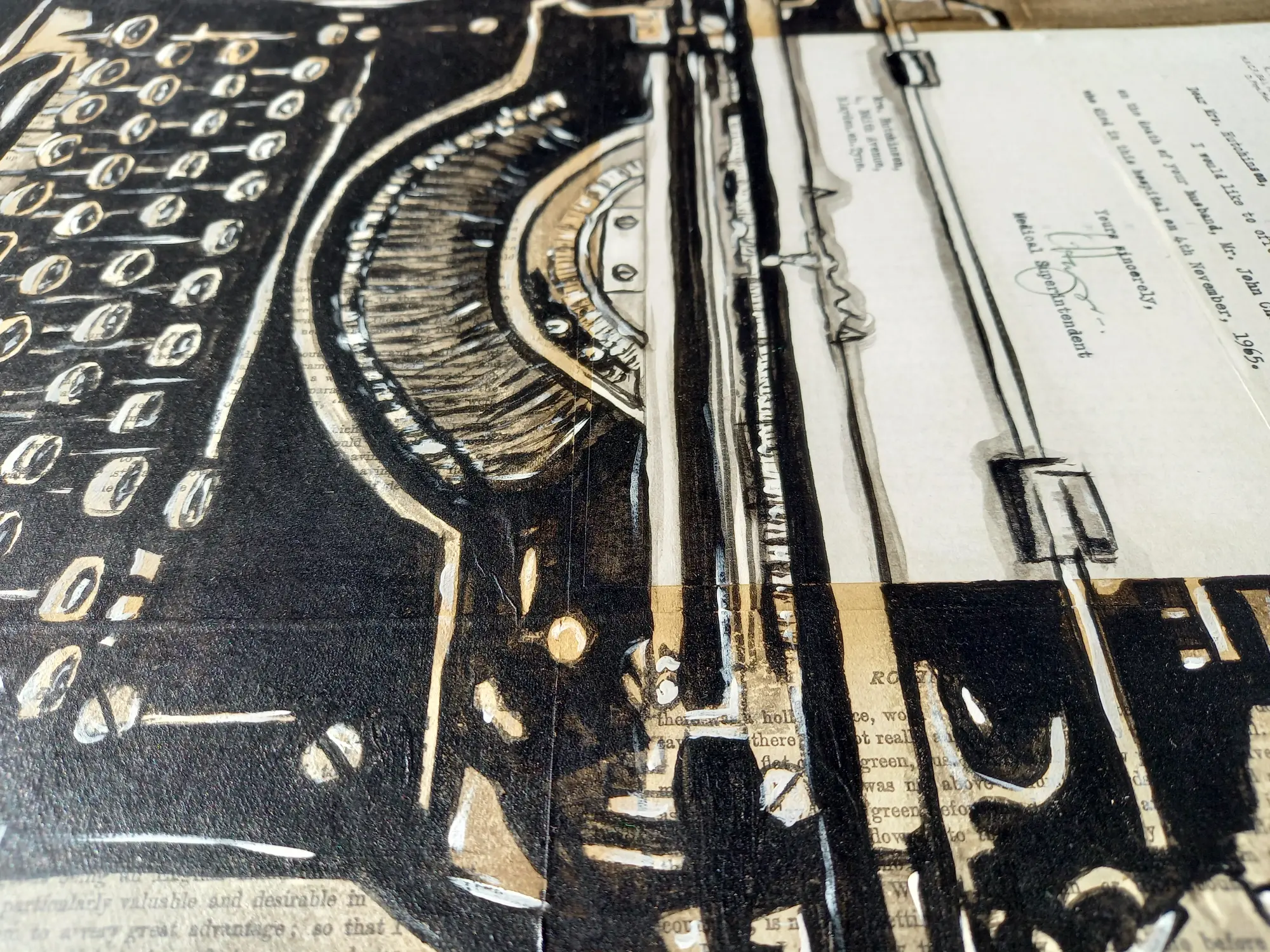
This painting began with a letter. Not a love letter, but a real one – hand-typed and dated 5th November, 1965. It was written from Gateshead and District Hospital to a woman named Mrs. Hutchinson, offering condolences on the death of her husband, Mr. John Charles Hutchinson, who had passed away the day before.
I found it tucked away at Kasbah Antiques, back when Dave still had the big market stall in North Shields (he’s now moved to Blyth, but I still visit him from time to time for a good rummage). Dave does house clearances, and this letter had clearly been kept safe for decades – presumably by Mrs. Hutchinson herself – until she too had passed, and her possessions were sorted and passed along.
The letter struck me. Yes, its contents are undeniably sad, but more than that, it felt like a small piece of social history. The kind of thing that would usually be thrown away – a typed notification of a life ended – but here it was, intact, 60 years later. I found myself wondering how many hand-typed letters like this still exist. Not many, I suspect. And that’s why I knew I had to preserve it – not in a frame or folder, but in paint.
At first, I thought it might become the background for a larger painting. But a few weeks later, I spotted a photograph of an old typewriter in an auction catalogue and everything fell into place. Rather than push the letter into the background, I decided to bring it to the front – quite literally.
I took an old canvas with a mass-produced print and covered it with pages from an aged book. The faded, tea-toned colour of the paper gave the piece warmth and contrast – making the crisp white letter stand out clearly in the centre. Then I carefully pasted the letter down and, over the top of it, sketched out a classic black typewriter, positioned as though it had just finished typing those very words.
The painting is minimal – deliberately so. No colour, just black acrylic and a few touches of white for highlights. That’s all it needed. Those old typewriters didn’t come in bright colours, and the subject didn’t ask for embellishment. It asked for respect, and clarity, and space.
Dear John was the first painting I placed in the gallery window while I was still getting the studio ready – and I wasn’t sure how people would respond. But every day since, people have stopped to look. Some pause to read the letter. Others, especially older passers-by, smile as they recall working on the same type of typewriter in their youth.
There’s something quietly moving about this piece. It holds a moment in time – a farewell, typed out with care – and reminds us how even small, forgotten objects can still speak, decades later.